VoIP numbers: Types, features, and benefits explained
Last Updated
Oct 14, 2026
Published On
Apr 27, 2026
 153
153
Table of Contents
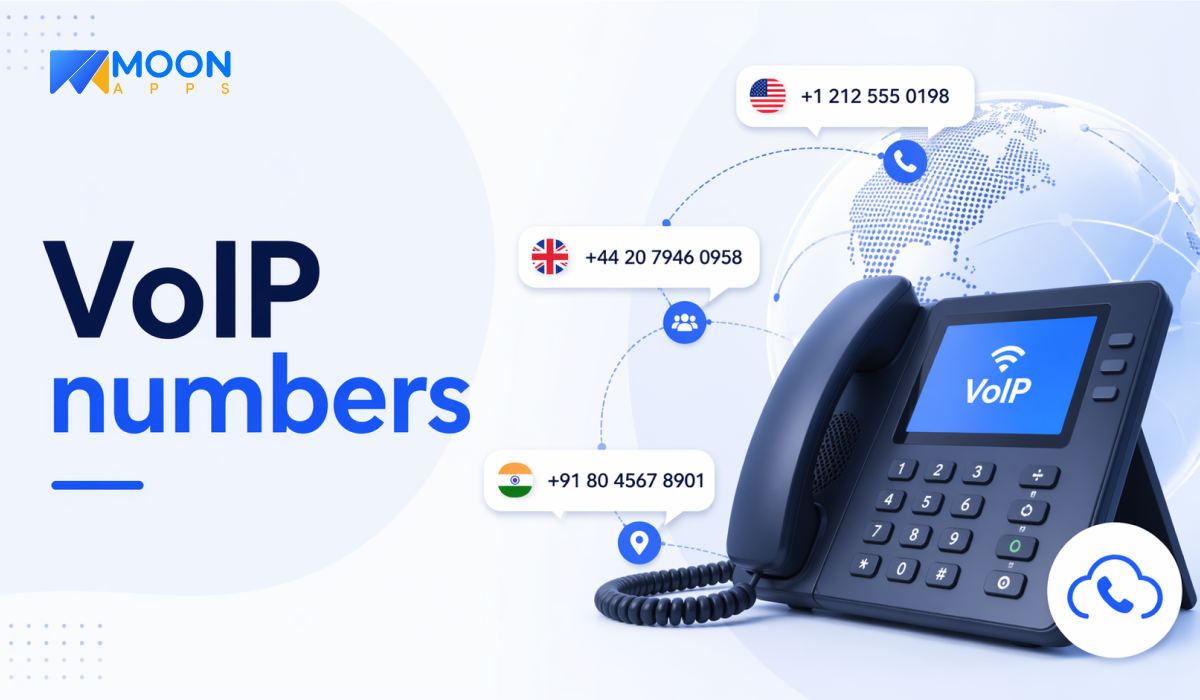
VoIP, or Voice over Internet Protocol, has completely transformed how businesses and customers make phone calls. Whether you run a large or small business, VoIP could be the most appropriate communication upgrade for your business.
VoIP is an essential part of the internet phone services, but the unique thing about VoIP is that it doesn’t require a physical device, a line, or even a SIM card. It operates over the internet and offers greater flexibility and savings than traditional landline phones.
So, you can already see how effective VoIP calls are and how they can shape your business in the long run. Let’s dive in and explore the VoIP number meaning, its types, working process, and key features.
📌 Key Takeaways
- A VoIP number is also known as a virtual phone number that businesses use for transparent business communication.
- VoIP numbers use the internet and cloud-based infrastructure to convert voice data into data packets and complete a call.
- Some of the key types of VoIP numbers include local VoIP numbers, toll-free numbers, international numbers, and vanity numbers.
- VoIP features such as auto-dial, call scheduling, and disposition status are primary reasons why businesses use VoIP calls.
What is a VoIP number? (VoIP number meaning)
VoIP is a virtual phone number that allows businesses or individuals to make calls and receive calls using the internet instead of traditional telephone lines. Unlike landline numbers, which are accessible only from a particular location, a VoIP number uses cloud-based systems, allowing you to communicate from anywhere.
In other words, it is a regular phone number, but the entire working process is powered by the internet. Traditional landline numbers rely on a physical telephone network, while VoIP numbers convert voice into digital data and transmit it over the internet. This is the primary reason why VoIP is cost-effective and suitable for modern businesses.
For example, a US-based business can dial its customers in the UK or Australia using a VoIP number. When the call is initiated, it is routed over the internet to the business’s device (either a smartphone, laptop, or VoIP-enabled desk phone).
Key characteristics of a VoIP number:
- No fixed location: Make or receive calls from any device, anywhere
- Internet-based mechanism: Traditional phone lines are not required
- Scalable: Easy to add or manage numbers when your business grows
It won’t be wrong to say that VoIP numbers offer a smarter, more adaptable way to stay connected than landline phones do.
Landline calls impacting your business communication?
Avoid landline setups that degrade your business communication with customers. Switch to a VoIP system now.
How does a VoIP number work?
VoIP operates on the internet connectivity and cloud-based infrastructure. It allows users to make and receive calls without any hiccups across devices and locations. Let’s explore the workflow of VoIP numbers below:
1. Voice conversion into data packets
The moment you start talking in the VoIP call, your voice is captured by your device, whether it is a laptop, tablet, or mobile phone. The system then converts your voice data into compressed digital signals, also known as data packets. These signals are divided into smaller parts to enable faster, more efficient transmission.
2. Transmission over the Internet
After the voice is converted into data packets, they are transmitted over your internet connection rather than traditional cellular networks. This transmission, without relying on physical infrastructure, ensures the call travels quickly across many different locations.
3. Routing through cloud servers
Once data packets are available on the internet, they pass through cloud-based VoIP servers. These servers correctly identify the best possible path for the call and route packets to the intended recipient. Routing is done regardless of the recipient’s device or location.
4. Reassembly at the receiver’s end
Once the data packets reach the recipient, they are reassembled in the same order as when the voice data was captured. It is converted back into audio. This step ensures the conversation remains smooth and uninterrupted.
5. Real-time voice playback
Lastly, the reassembled audio or voice is played back to the recipient in real time. This whole process is done in milliseconds, which makes VoIP calls feel as natural as traditional telephone calls.
Additionally, cloud infrastructure and IP addresses also play a major role in delivering stable and seamless connectivity. IP addresses make sure the call reaches the correct destination, while cloud infrastructure finds the most efficient path for the call.
VoIP services are managed in the cloud, which allows you to switch devices and scale operations without changing your number or setup.
Different types of VoIP phone numbers
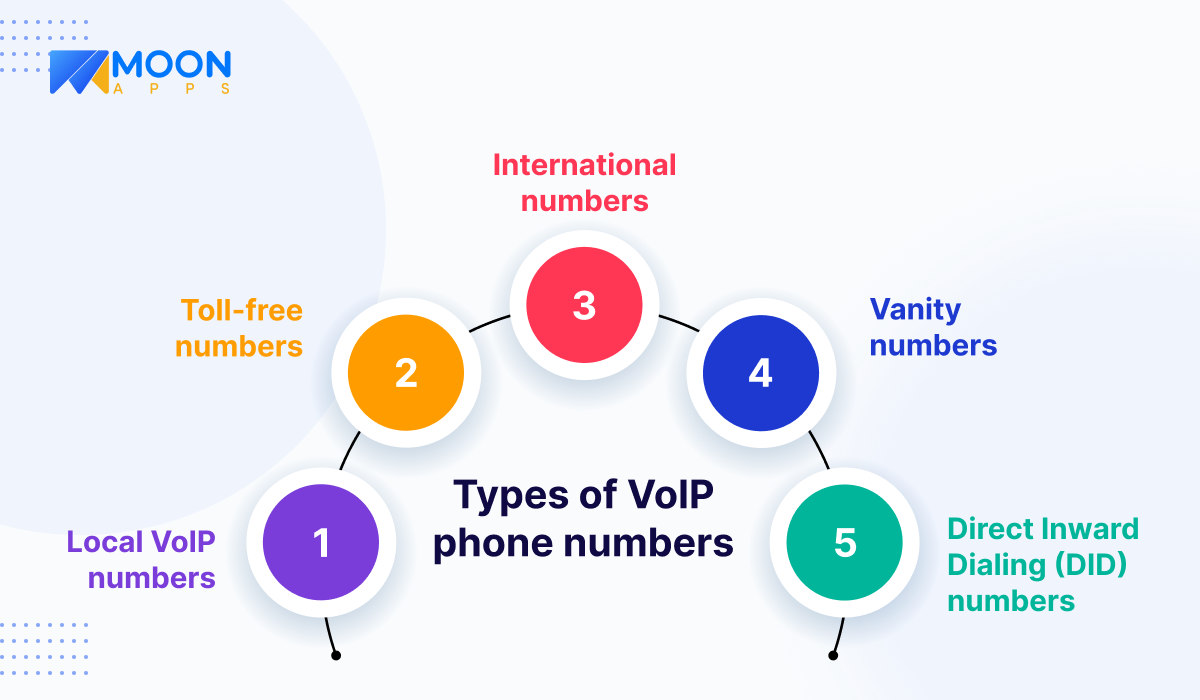
VoIP numbers come in multiple types, depending on specific communication needs. Below are some key types of VoIP telephone numbers to consider for your business.
1. Local VoIP numbers
VoIP numbers that are useful only within one specific geographic area are known as local VoIP numbers. It allows businesses to establish a local presence in a city or region without being physically located there. Local VoIP numbers could be a reliable option for your business to communicate daily with local customers.
Best use case:
Startups and small businesses use local VoIP numbers to boost their sales with local customers.
2. Toll-free numbers
Toll-free VoIP numbers are incredibly handy for businesses, as they don’t incur call charges. Customers who hesitate to contact your business due to call charges can freely make voice calls, ultimately broadening your reach.
Best use case:
Highly suitable for customer support teams or helplines where customer assistance and query solving are involved.
3. International numbers
Many medium to large-scale businesses use international VoIP numbers to have a virtual presence in multiple countries. With international VoIP numbers, handling international calls becomes easier, as there is no need for a physical office setup abroad.
Best use case:
Outsourcing companies or organizations that target customers from different countries use international VoIP numbers.
4. Vanity numbers
Vanity numbers are also known as customizable phone numbers that spell out a word or a brand name, such as 1-700-CAR-RENT. Vanity VoIP numbers are very different from traditional phone systems, and they allow you to set up and manage these customizable numbers for improved customer experience.
Best use case:
Vanity VoIP numbers are mostly useful for marketing and branding a business by improving recall.
5. Direct Inward Dialing (DID) numbers
DID, or Direct Inward Dialing, refers to the use of multiple extensions within an organization that can be reached directly without going through a central operator. With a VoIP phone service, each department in your business can have its own DID number.
Best use case:
Useful in large-scale businesses where efficient call routing and direct communication are required with specific teams or individuals.
VoIP phones vs landlines: Key differences
So far, we have understood what is a VoIP number. Now, let’s explore some key differences between VoIP phones and landlines to better understand them.
Landlines are traditional phone services, while VoIP phone systems are the latest and most advanced communication technology in terms of features, usability, and value for your business.
Here are the key differences between VoIP phones and landlines:
| Comparable factors | VoIP phones | Landlines |
|---|---|---|
| Call quality | Depends on the internet speed and stability | Generally consistent and stable |
| Device compatibility | Works on smartphones, laptops, and VoIP phones | Works only on landline handsets |
| Global reach | Supports international communication | Expensive and limited for global calls |
| Mode of transmission | Internet (data networks) | Copper phone lines |
| Multiple device support | Easy to switch from one device to another, as it doesn’t require cable wiring | Tied to one specific device; does not support access for multiple devices |
| Cost efficiency | Lower costs, especially for long-distance and international calls | Higher costs for setup, maintenance, and long-distance calls |
| Mobility & flexibility | Use anywhere with internet access | Fixed to a specific location |
| Scalability | Easily add users or numbers | Limited and requires physical expansion |
| Integration capabilities | Integrates with CRM and business tools | No integration capabilities |
How can you get a VoIP number?
Getting a VoIP number is not as complex as one might think. It is affordable, and you can get a VoIP telephone number easily by following the simple steps below.
- Choose a reliable VoIP service provider: To get a VoIP number, you should research well on the internet about top VoIP providers and, based on your requirements, choose one. There are many VoIP providers on the internet, such as Moon Dialer, that offer VoIP calls at affordable prices.
- Select your plan: Once you choose your VoIP provider, the next step is selecting a suitable plan to start your VoIP services. You can get started by either selecting a monthly or yearly plan based on your requirements.
- Add your number: Once you’ve selected your plan, add your number. You will get an OTP (One-Time Password) to confirm your number on the dialer app. After OTP confirmation, add additional details such as name, email address, caller ID, and profile image.
- Ensure a stable internet connection: To initiate your VoIP call, you need a stable internet connection, i.e., sufficient bandwidth for high-quality calls.
Key features of VoIP numbers
The biggest reason businesses shift from traditional landline connections to VoIP is the features it offers. Let’s explore some of the top features of VoIP numbers.
1. Auto-dial
You can start auto-dials from contacts, campaigns, disposition status, or an imported contacts list. Once you initiate the call, all listed contacts are dialed automatically one by one.
2. Call handling
Every call is handled precisely with auto-attendants (virtual receptionists), call queuing, call forwarding, etc.
3. Communication integration
Seamless integration with CRM systems, email, and chat, which further extends VoIP features such as click-to-dial from a web browser or voicemail-to-email, etc.
4. Virtual number & local presence
Businesses can remain in their preferred local location and still operate across different regions virtually, using specific area codes.
5. Portable number
Switching between VoIP providers is easier than switching landline numbers. Plus, in case of any emergency, VoIP allows businesses to immediately move numbers internally between users.
Losing money due to hefty international charges per call?
Say goodbye to old telephone connections and switch to Moon Dialer for your iOS to make international calls with no additional charges.
Benefits of using VoIP phone numbers
VoIP phone numbers offer several practical advantages for modern businesses, especially when it comes to flexibility, cost management, and handling communication more efficiently. Below are some of the bigger benefits of using VoIP systems instead of landlines.
- Cost-efficient: A dedicated phone line connection is not required, and VoIP costs significantly lower than traditional phone systems.
- Flexibility: Offers greater usability and mobility than landline phones, as it can be used from anywhere rather than being tied to a single location.
- Multiple device compatibility: One VoIP number can be used across multiple devices, such as smartphones, tablets, and laptops, to make or receive calls.
- Greater convenience: Allows you to communicate with your audience base even when they are in another country, at any time you want, from any device.
- Toll-free numbers: Customers contact the business for even small queries, as there is no cost, which ultimately improves customer interactions.
- Improved voice quality: VoIP calls are often clearer than landlines, which are prone to disruptions and noise.
Get an advanced VoIP calling app for seamless communication
Believe it or not, VoIP technology is slowly taking over the traditional phone lines worldwide. In today’s digital world, an internet connection is a bare minimum. The easy affordability of internet services makes VoIP calls a solid choice over traditional landline phones. Plus, other advantages of VoIP numbers include international calling and toll-free numbers, which make conversations transparent.
So, if you are planning to switch to an advanced VoIP calling platform, Moon Dialer is your answer! Whether you prefer Android, iOS, or Windows, Moon Dialer is compatible with all platforms.
The application includes features such as SIM-free calling, call forwarding, scheduling, recording, auto-dialing, campaign creation, instant calling via QR code, and cloud sync for storing or retrieving data whenever required.
Explore the Moon Dialer today and make your business conversation worthwhile!
FAQs
To get a VoIP number, first you need to choose a reputable VoIP service provider. Next, you should select your plan, add your number, and initiate your VoIP calls instantly. If you are looking for an affordable VoIP call application, Moon Dialer can be the right choice for your business.
VoIP, or Voice over Internet Protocol, is used for effective communication in businesses. It allows customers to make calls, send SMS messages, and use other telephony features on any device, from anywhere.
Yes, you can easily get a VoIP number for free. But, unfortunately, free VoIP numbers come with basic features that may stifle your communication mode. What you can do is get Moon Dialer, an advanced software that offers all the necessary features at an affordable price.
Yes, you can use your current cell phone number for VoIP calls. When you use VoIP, you can connect with international customers without worrying about calling charges. Plus, another advantage is that you will get high-quality voice calls from any device, anywhere; you just need a stable internet connection.
Share Article: