Lead capture vs. lead retrieval: What’s the difference?
Last Updated
Nov 24, 2026
Published On
Nov 24, 2026
 17
- What is lead capture?
- What is lead retrieval?
- Lead capture vs. lead retrieval: Key differences
- Can lead capture and lead retrieval work together?
- Why does a business need a lead capture app?
- Essential features to look for in a lead capture app
- How does Exhibition Lead Capture by Moon Apps help businesses?

Lead Capture vs. Lead Retrieval
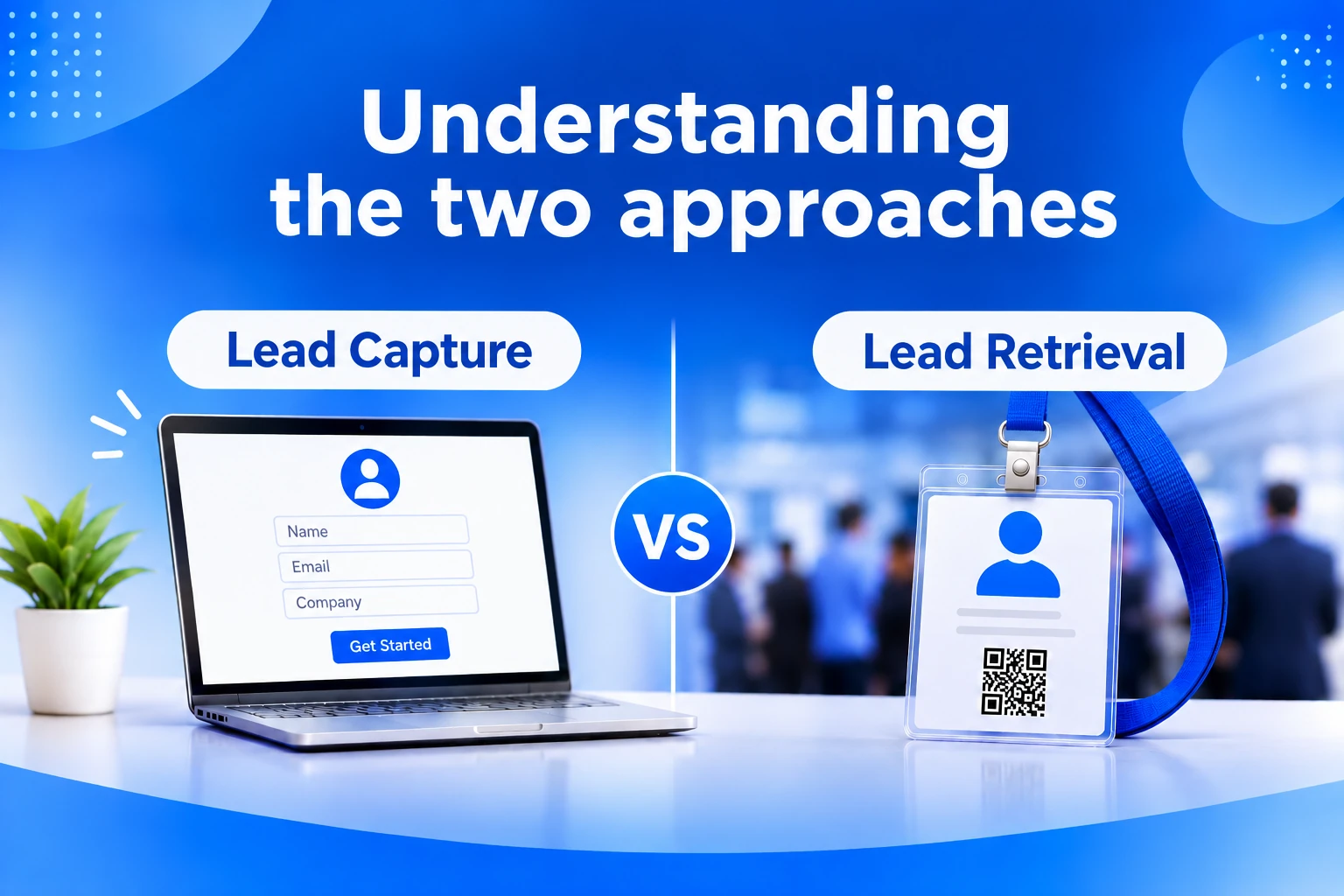
Lead capture and lead retrieval help businesses collect and manage potential customer details. While lead capture gathers information through multiple marketing channels, lead retrieval focuses on collecting attendee details at an event. Together, they support better lead management, timely follow-up, and increased sales opportunities.
In today’s competitive environment, collecting client information is essential for generating sales opportunities. Businesses use different techniques to gather prospect details. Two common approaches are lead capture and lead retrieval. Both approaches help businesses collect potential customer information. However, they serve different purposes and are used in different situations.
Lead capture helps businesses collect prospect information through websites, forms, landing pages, and other marketing channels. Lead retrieval, on the other hand, focuses on gathering attendee details at trade shows, conferences, exhibitions, and badge-scanning apps.
Let’s explore lead capture vs. lead retrieval to understand the difference between the two approaches. We’ll also learn how they work together.
📌 Key Takeaways
- Lead capture involves collecting potential customers’ information through landing pages, social media, and other channels.
- Knowing the difference between lead capture and lead retrieval helps you choose the right approach and tools to collect prospect information.
- Lead retrieval involves collecting and accessing attendee or prospect information at the event.
- Businesses can use both together to build a stronger sales pipeline and improve lead management.
- Lead capture software or an app helps businesses collect, organize, and manage prospect information efficiently.
What is lead capture?
Lead capture is a process of collecting information from potential customers who show interest in a business’s products or services. Typical information includes names, company details, phone numbers, email addresses, and other relevant details.
Businesses can use contact forms, website forms, landing pages, QR codes, and social media campaigns to collect this information. At exhibitions and business events, trade show lead capture helps exhibitors collect visitor details and identify potential customers.
Why is lead capture important?
- Turns anonymous visitors into known contacts: Most visitors leave without a trace, and capture gives you a way to reach them again.
- Builds a prospect database: Collected details become an asset your marketing and sales teams can use over time.
- Enables nurturing: With contact details, you can send relevant content and stay in touch until the prospect is ready to buy.
- Helps qualify prospects: Form answers and behavior data (pages viewed, offer downloaded) show who is genuinely interested.
- Improves marketing efficiency: You can see which channels and campaigns bring in leads and focus spend on what works.
- Supports sales growth: A steady flow of interested prospects feeds the sales pipeline.
What is lead retrieval?
Lead retrieval is a process of scanning or recording attendee details at trade shows, conferences, exhibitions, and other business events. It helps businesses identify interested attendees and gather their details for future communication and sales follow-ups.
Lead retrieval typically uses badge scanners, QR codes, event apps, or digital registration systems to collect attendee information such as names, email addresses, phone numbers, and company details.
Why is lead retrieval important?
- Captures leads quickly in a busy setting: A badge or QR scan takes seconds, so reps can keep talking to the next visitor.
- Reduces manual errors: It replaces paper forms and business cards, which are slow to enter and easy to misread or lose.
- Records conversation context: Reps can add notes or a rating (hot, warm, cold) on the spot, while the conversation is fresh.
- Enables fast follow-up: Leads arrive organized and prioritized, so sales can contact the best prospects soon after the event.
- Keeps event contacts in one place: All scans from the team sync into a single list instead of scattered notes and cards.
- Measures event performance: You can track lead volume and quality and compare events against their cost.
Fact to know
According to the Growth Market Report, the trade show lead retrieval market is expected to reach USD 3.01 billion by 2034, a CAGR of 9.8%.
Lead capture vs. lead retrieval: Key differences
The difference between lead capture and lead retrieval is about their purpose, methods, and use cases. Lead capture focuses on gathering prospect information across various marketing channels. Lead retrieval, however, helps collect attendee details at trade shows and events.
| Aspects | Lead capture | Lead retrieval |
|---|---|---|
| Meaning | The broad practice of collecting contact details from interested prospects across any channel. | A specific form of lead capture: scanning or recording attendee details at in-person events. |
| Primary purpose | Turn anonymous visitors into known contacts you can nurture and convert. | Turn booth conversations into qualified leads ready for fast sales follow-up. |
| Where it’s used | Mainly online: websites, landing pages, social media, and email campaigns. | In person only: trade shows, exhibitions, and conferences. |
| Methods | Web and landing page forms, gated content, pop-ups, chatbots, lead ads, and QR codes. | Badge scans, QR code scans, and event app check-ins. |
| Target audience | Website visitors, social media users, and people who respond to ads or email campaigns. | Event attendees who visit your booth or sessions. |
| Data collection | Details the prospect types themselves (name, email, company, inquiry), plus digital behavior such as pages viewed & campaign source. | Details pulled from the attendee’s registration record (name, email, phone, company, job title), plus the rep’s notes and lead rating. |
| Tools used | Form builders, landing page tools, chatbots, marketing automation, and a CRM to store leads. | Badge scanners, event lead retrieval apps, and event management platforms. |
| Expected outcome | A growing database of known prospects for marketing nurturing and sales outreach. | A prioritized, rated list of event leads for rapid post-event follow-up. |
Turn business cards into business opportunities.
Quickly capture contact information from every visitor’s business card with Exhibition Lead Capture by Moon.
Can lead capture and lead retrieval work together?
Combining lead capture and lead retrieval strengthens event lead management, helping businesses organize attendee information, track prospect interactions, and simplify post-event follow-ups. Although they serve different purposes, combining both processes allows businesses to gather leads from multiple channels and maintain a consistent sales pipeline.
The following are ways to combine both approaches:
- Collect leads from multiple sources: Utilize lead capture forms to gather information from website visitors. Businesses can also use lead retrieval tools to collect attendee details at business events.
- Centralized system: Store leads collected through both processes in a centralized CRM or lead management system.
- Segment potential customers: Categorize prospects by interests, source, industry, or engagement level.
- Simplify follow-ups: Use the collected information to send personalized emails, schedule meetings, and connect with interested prospects.
- Track lead performance: Analyze leads from different sources to understand which marketing channels and events generate better opportunities.
Why does a business need a lead capture app?
A lead capture app helps businesses collect, organize, store, and manage potential customer information from different sources. It reduces reliance on spreadsheets and manual entry by letting businesses capture prospect details more efficiently in a dedicated app. Some reasons for using a lead capture application are as follows:
Simplifies lead collection
Lead capture software or an app makes it easier to collect potential customer information through digital forms, QR codes, and other data-collection methods. It reduces manual work and helps businesses gather prospect details more efficiently.
Reduces manual data entry
Manually recording customer information can be time-consuming and error-prone. A lead capture app automates data collection, reduces repetitive tasks, and minimizes the chance of incorrect entries.
Keeps lead information organized
Businesses often collect prospect information from multiple marketing channels and events. A trade show lead capture app helps store these details in one centralized location, making it easier for sales teams to access and manage leads.
Improves lead follow-ups
Timely communication plays an important role in converting prospects into customers. With readily accessible contact information, sales representatives can follow up with interested prospects, share relevant details, and nurture potential opportunities.
Supports better lead management
A lead capture app helps businesses categorize and manage prospects by interests, requirements, and engagement. This allows sales teams to prioritize promising leads and focus on relevant opportunities.
Improves team collaboration
Sales and marketing teams can access shared lead information, coordinate follow-up activities, and stay updated on prospect interactions. This improves collaboration and reduces the chances of missing potential opportunities.
Helps measure lead generation performance
Businesses can review collected lead information to understand which marketing campaigns, channels, or events generate the most prospects. These insights help them evaluate lead-generation efforts and make informed marketing decisions.
Essential features to look for in a lead capture app
Choosing the right lead capture application can significantly affect how businesses collect, organize, and manage prospect information. Here are some essential features to look for in a lead capture app.
QR code scanning
QR code scanning makes it easier to collect prospect information at events, exhibitions, and networking sessions. It lets sales representatives scan QR codes and retrieve attendee details without manual data entry.
Offline data collection
Internet connectivity may not always be reliable, especially at crowded events or remote locations. Offline data collection lets businesses capture and save prospect information without an active internet connection, then sync it when connectivity returns.
Lead categorization and segmentation
Look for an app that lets you categorize leads by interests, industry, location, source, or engagement level. This helps sales teams prioritize prospects and plan targeted follow-ups.
Real-time data synchronization
Real-time synchronization ensures that collected lead information is updated across connected devices and platforms. It allows team members to access the latest prospect details and collaborate more effectively.
Data security and privacy
A lead capture app should offer appropriate security measures to protect sensitive customer information. Look for features such as data encryption, access controls, secure cloud storage, and privacy compliance options.
Third-party integrations
Integrations with marketing automation tools, email platforms, and other business applications help create a connected workflow. They make it easier to share lead information and coordinate marketing and sales activities.
How does Exhibition Lead Capture by Moon Apps help businesses?
Managing potential customers at trade shows, exhibitions, and conferences can be challenging. Major problems include misplaced business cards, manual data entry, and delayed follow-ups that can miss sales opportunities.
Exhibition Lead Capture app simplifies this process by helping businesses capture, organize, classify, and manage prospect information through a single application. It offers several useful features that help sales and marketing teams make the most of every business event.
Captures leads from business cards: Businesses can scan visitors’ business cards and extract contact information using OCR technology. This reduces manual data entry and makes it easier to save prospect details.
Collects professional details from LinkedIn: The app supports LinkedIn lead capture, allowing businesses to collect and store professional contact details from LinkedIn profiles.
Records conversations with voice notes: Sales representatives can record conversations and important follow-up details while interacting with exhibition visitors.
Classifies leads by priority: The app allows businesses to categorize prospects as Hot, Warm, or Cold. This makes it easier for sales teams to prioritize prospects and plan relevant follow-up activities.
Manages multiple exhibitions: Businesses participating in multiple exhibitions can create and manage different events through the application.
Improves team collaboration: Multiple team members can capture and manage leads within the same exhibition. This helps sales teams coordinate their activities and manage collected leads more effectively.
Stores supporting media and documents: Businesses can attach images, documents, and other supporting files to individual lead records.
Tracks performance with reports and analytics: The reporting and analytics feature helps businesses monitor lead statistics and team performance. Users can also export reports in PDF and CSV formats for further analysis and recordkeeping.
Is it exhibition time? Don’t miss your potential lead.
Use the Exhibition Lead Capture app to capture visitor details instantly and build valuable business connections.
FAQs
Lead generation refers to attracting potential customers who may be interested in your product or service. Its main focus is building awareness and interest and encouraging prospects to engage with the business. On the other hand, lead capture is a process of collecting contact details and other relevant information from potential customers who show interest in your business. It helps businesses turn interested prospects into identifiable leads for future follow-ups.
Neither approach is better, as each serves a different purpose. The right choice depends on where you meet your prospects. Lead capture works best for online channels, lead retrieval works best for in-person events, and most businesses use both.
To manage lead capture efficiently, you must follow these strategies:
- Use a dedicated lead capture app to collect and organize prospect information in one place.
- Gather only relevant details, such as names, email addresses, phone numbers, and customer interests, using digital forms or QR codes.
- Categorize leads by interest, industry, or purchase intent to make prioritization easier.
- Integrating lead capture tools with a CRM system can further simplify data management and sales follow-ups.
- Contact prospects promptly through personalized emails or calls.
- Regularly monitor metrics such as lead volume, conversion rates, and response rates to identify opportunities for improvement.
Yes, lead retrieval can be useful for small businesses, especially those participating in trade shows, exhibitions, conferences, and networking events. It helps them collect attendee information by scanning event badges or QR codes, reducing manual data entry and saving time. Small businesses can use this information to identify potential customers, organize leads, and follow up with interested prospects after events.
Share Article: