How to trace a VoIP number? 6 methods to consider
Last Updated
Nov 16, 2026
Published On
Nov 16, 2026
 28

You pick up a call from an unfamiliar number. It isn’t in your contacts, the area code doesn’t match any city you do business in, and the caller hangs up before you can say hello. Later, you discover it came from a VoIP number. It is a very inexplicable feeling.
For businesses and startups, VoIP calls are normal. They’re part of business activities like resolving customer queries or assisting potential customers. However, repeated spam or suspicious “vendor” calls can cost time, money, and also peace of mind.
So, the question is: can VoIP calls be traced?
The honest answer is: yes, you can trace a VoIP number, but only up to a point. Because VoIP numbers run over the internet rather than a fixed telephone line, they are very difficult to pin down.
Moving ahead, we will find out how to trace a VoIP number, along with how you can identify spam VoIP calls. So, let’s get started…
📌 Key Takeaways
- The number used to make calls over an internet connection instead of through network operators is called a VoIP number.
- VoIP numbers are of two types: fixed VoIP numbers and non-fixed VoIP numbers.
- Online number search and reverse lookup services are two of the best methods to trace VoIP calls.
- Reviewing caller ID and VoIP service records are the other two primary methods for tracing VoIP calls.
- Unusual payment requests, pressure, and urgency are primary signs of spam VoIP calls.
What is a VoIP number?
A VoIP number refers to a phone number that makes and receives calls over an internet connection. In technical terms, it is called Voice over Internet Protocol (VoIP), which works without a traditional phone line.
VoIP converts your voice into a digital signal that travels over the internet, and if you are calling a regular phone number, the signal is converted back at the other end.
Transform Your Business Calls with Advanced VoIP
Unlock next-gen features to enhance your VoIP calling. Call recording, scheduling & forwarding & many more!
Types of VoIP services
VoIP services differ in how and where users can access them. Generally, they are of two types, and knowing these can help you get closer to tracing VoIP numbers. Here they are:
1. Fixed VoIP numbers
They are associated with a specific physical access point, such as a home or office. The service uses a device connected to that location, which makes its usage location more consistent.
Under FCC rules, providers of fixed interconnected VoIP services must also provide an automated, dispatchable location for 911 calls.
2. Non-fixed VoIP numbers
They allow users to make calls from multiple locations using internet-connected devices. Often described as nomadic or mobile VoIP, these services offer greater flexibility because users aren’t restricted to one physical access point.
However, providers may still collect registered location information for emergency services, and users may need to update it when they move.
Important point to note:
Fixed and non-fixed VoIP services may not provide an exact pinpoint location of a VoIP call. They also do not reveal the caller’s identity.
How can VoIP calls be traced? – 6 methods revealed
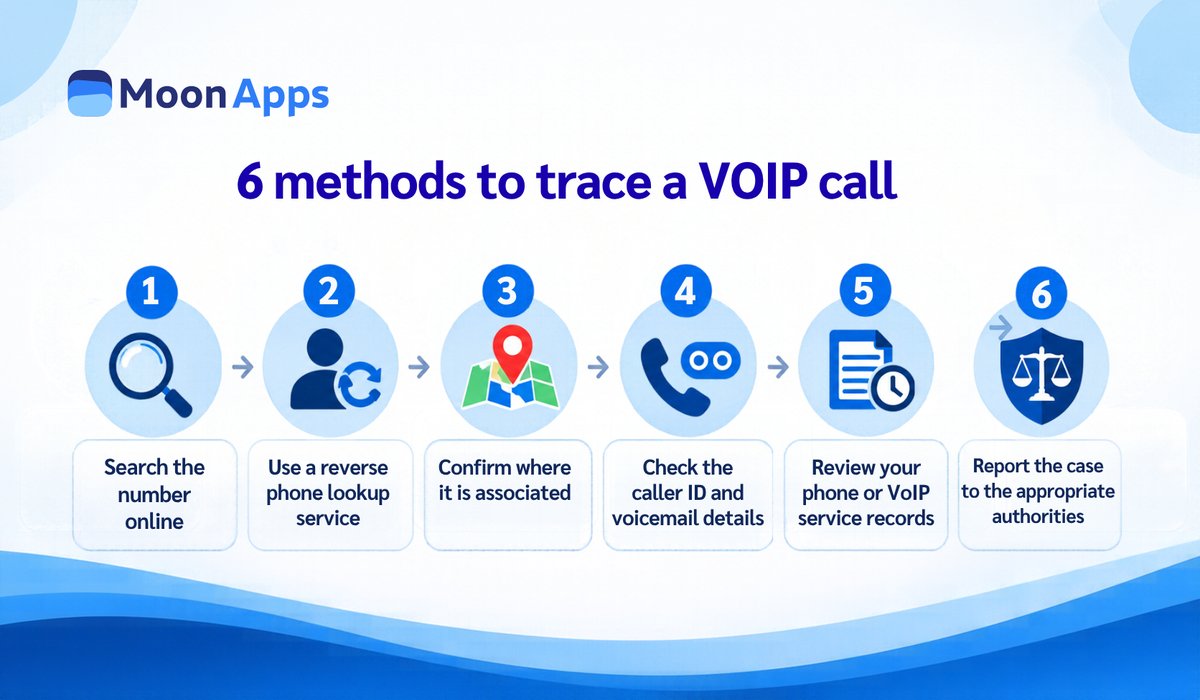
You can trace a VoIP number or call only if you have the required information and checking details. Gather every detail you can about the VoIP call, then follow the methods below to trace the number.
1. Search the number online
When you get a VoIP call, it is a no-brainer that a VoIP number is associated with it. To trace it, first enter the full number in a search engine. Try searching without the country code, but put it in quotation marks. It helps you find pages that mention the exact number.
Next, look for business directories, official company websites, and reports from people who have received calls from the same number. If the number is associated with a business, you will easily find its name and contact information.
Key to note here is: you should avoid jumping to conclusions before comparing results from multiple sources. Reported complaints don’t necessarily point to spam calls. You need to check sources carefully.
2. Use a reverse phone lookup service
A reverse phone lookup starts with the number and works backward. This means you are not searching for who owns the number, but for information associated with it. Depending on the service and its available records, you may find a possible caller name, business listing, carrier, number type, or spam reports.
Next, you need to choose a reputable service that explains where its information comes from. Some services include a free option for basic searches and charge for more detailed reports. Treat both paid and free options with the same caution, especially when the service can’t explain how it verifies identities.
Use reverse lookup as a starting point, not proof of identity, because it doesn’t clearly identify the person who placed the call. Its records could be incomplete or inaccurate.
3. Confirm where it is associated
To see whether a number uses VoIP, use a reputable phone number lookup tool, such as Truecaller or NumLookup, that reports the number’s line type or serving carrier. Depending on the number and the tool’s coverage, the result may indicate whether it is classified as wireless, landline, or VoIP.
The information you get from the lookup tool will help you find the carrier provider associated with the number. But it does not confirm who used it to make a particular call.
Keep in mind that number portability, resellers, and changes in service arrangements can affect lookup results. So, treat the listed provider as a useful reference rather than definitive proof of which service handled the call.
4. Check the caller ID and voicemail details
Another way to trace a VoIP number is to review the caller ID name, displayed phone number, and any voicemail the caller left. If the caller claims to represent a company or government agency, look for details that you can verify independently.
Next, visit the organization’s official website (the one the caller mentioned) and contact their team to confirm the call was legitimate. Avoid calling back suspicious voicemails or messages.
Remember, caller ID can be impersonated or faked. The caller’s original calling number can be hidden, and the number that appears on your screen can be duplicated. The FCC warns that callers can deliberately falsify caller ID information to disguise who they are.
5. Review your phone or VoIP service records
The next method is to check your phone’s call history for the displayed number, call time, duration, and any associated voicemail. This is where having a business phone dialer app such as Moon Dialer can make the difference. Using a business phone app, you can quickly review call logs, recordings, call time, and call duration in one place.
In some cases, certain apps allow you to ask the administrator to collect important details. This information helps you establish when the call occurred and document a pattern of repeated spam calls.
6. Report the case to the appropriate authorities
If you suspect anything unusual in the call, you can report the call to your phone service provider. Share the displayed number, date and time of the call, relevant voicemail or messages, and a brief explanation of what happened. The provider can check its own logs and, if the caller is a registered customer, take action on the account.
Be realistic about what to expect. Providers are bound by privacy rules. For example, in the US, the FCC requires interconnected VoIP providers to protect customers’ calling records. So, they’re more likely to investigate and act than simply give you the caller’s identity.
Also, not to forget, tracing can take time if the caller used a VPN, shares an IP address with other numbers, or never registered properly.
Information to collect before reporting a VoIP call
Whenever you suspect a VoIP call is unfamiliar and asking and creating urgency, you need to gather the following details of the VoIP call to report it.
- The number that received the call.
- The number shown on caller ID, even if you suspect it’s spoofed.
- Any callback number the caller gave you.
- The date, time, and duration of each call.
- Voicemails, text screenshots, and notes on what the caller claimed.
- Names, company names, or case numbers the caller used.
- Call detail records exported from your provider or dashboard.
- Payment records, if you lost money.
How to report suspicious VoIP calls?
Once you gather all the information about a call involving fraud, threats, or harassment, report it immediately. In the US, you can report in two ways:
- File a complaint with the FCC. The FCC doesn’t resolve individual complaints, but reports inform policy and enforcement actions.
- Report unwanted calls to the FTC through DoNotCall.gov if you didn’t lose money, or through ReportFraud.ftc.gov if you did or have details about the scammer.
VoIP call tracking using IP address
VoIP calls use internet connections to transmit voice data, but tracing a call through an IP address is not as simple as looking up a phone number. A VoIP phone number does not publicly reveal the IP address of the device used to make a call.
Most VoIP service providers maintain technical records of call routing and connections, depending on their infrastructure and retention policies. So, this information is not generally available through a standard reverse phone lookup. Access may require the provider’s cooperation and appropriate legal authorization.
Even when an IP address is available, it may belong to a proxy, VPN, or intermediary server rather than the caller’s device. Therefore, an IP address alone cannot reliably establish the caller’s identity.
If you are investigating a suspicious or threatening call, save the call details (note them or take a screenshot) and report the incident to your service provider. They can advise whether they can investigate further through legitimate channels.
How to identify spam VoIP calls?
Identifying spam VoIP calls is similar to identifying normal spam calls. However, you need to be extra cautious as scammers often use internet-based calling services to make fraudulent calls. Here are some of the warning signs you must consider:
- Unfamiliar numbers that look local: Scammers may use neighbor spoofing to make a call appear to come from a local number. Repeated calls displaying different numbers can also be suspicious.
- Pressure and urgency: Be cautious if a caller threatens arrest, legal action, account closure, or service disconnection unless you act immediately.
- Unusual payment requests: Requests to pay through gift cards, cryptocurrency, or wire transfers, especially under pressure, are common fraud warning signs.
- Requests for sensitive information: Never share passwords, one-time verification codes, or banking details with an unexpected caller. Be equally cautious if they ask you to install software or grant remote access to your device.
- Demands for secrecy: A caller who tells you not to contact your bank, employer, family, or authorities may be trying to prevent you from verifying their claims.
- Suspicious automated behavior: Unexpected recorded messages, repeated robocalls, or unusual pauses before a representative speaks. It warrants caution, particularly when combined with other warning signs.
Don’t Let Suspicious Call Details Slip Away
With Moon Dialer, record conversations, check call history, and revisit important details without juggling over paperwork.
Stay on top of your VoIP calls with Moon Dialer
Spam calls and caller ID spoofing can make it difficult to verify who’s behind an unfamiliar call. Finding the exact caller ID isn’t easy, but accurate records can help you review conversations when something seems suspicious.
With Moon Dialer, businesses can record calls and access call logs to review past conversations and displayed phone numbers. These records can support an investigation if you fall for a fraudster.
Beyond call records, Moon Dialer helps businesses schedule calls, auto-dial contacts, create calling campaigns, and assign disposition statuses after calls end.
Elevate your calling workflow today by using a reliable calling app, Moon Dialer.
FAQs
Often, yes, but how far you get depends on the number. Fixed VoIP numbers are tied to an address and are easier to trace, whereas non-fixed numbers are much harder. Individuals rarely have access to the underlying records, so the most effective routes are the provider and, for serious cases, law enforcement.
Yes, it is possible, but not always. A fixed VoIP number is linked to a registered address, while a non-fixed number isn’t linked to any address. An IP address lookup usually gives only an approximate location and the internet provider. An exact location generally requires provider records and legal process.
A reverse VoIP number lookup identifies an unknown internet-based phone number’s carrier, line type (fixed or non-fixed), and the name or business associated with it (if available).
You can identify who is calling from a VoIP number by using a reverse phone lookup service or contacting your phone or VoIP service provider. More advanced options include checking call headers or using packet analyzers to inspect the incoming call’s technical data.
Share Article: